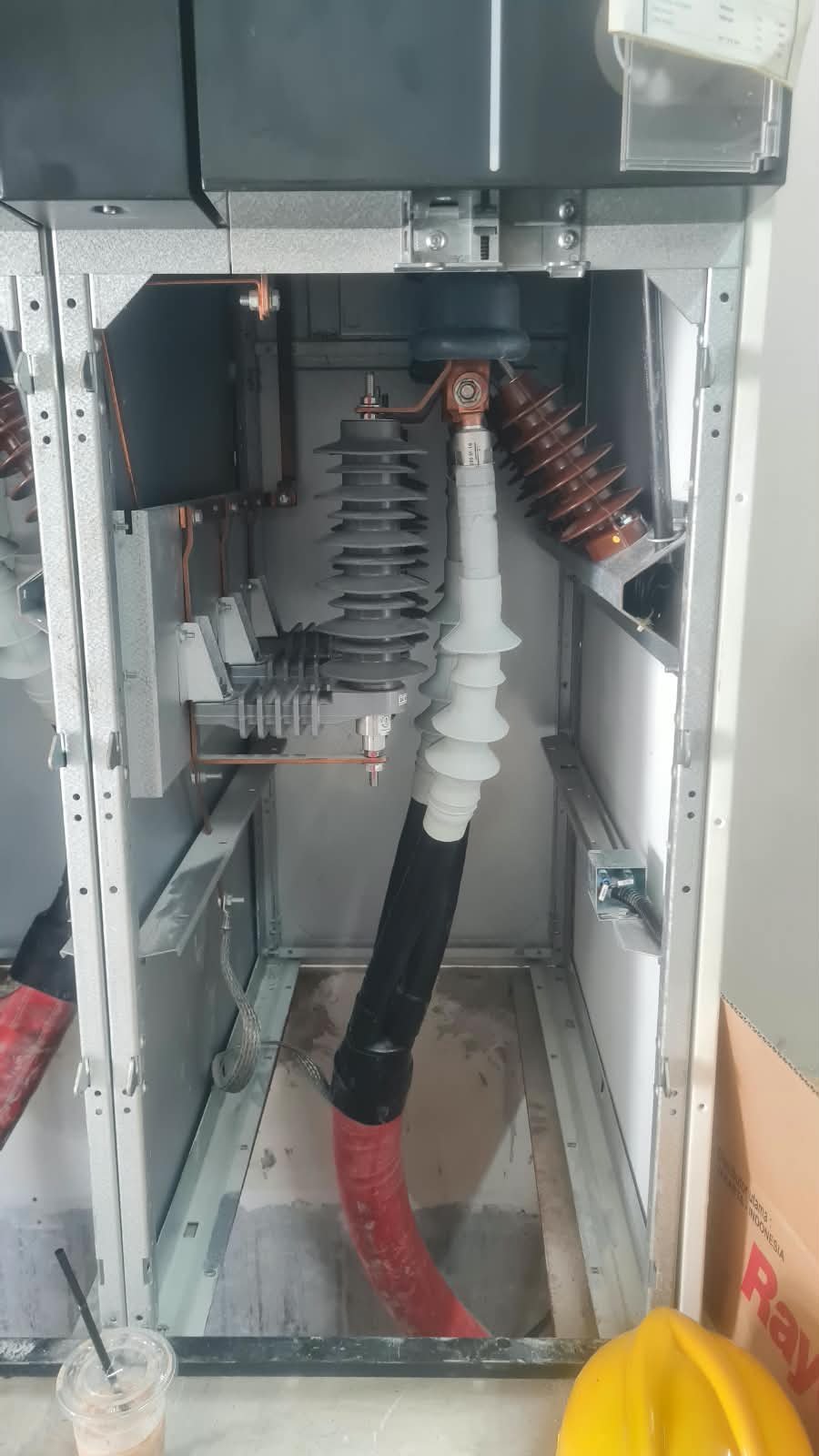
Underground 20 kV XLPE cable joints and terminations represent the most electrically stressed points in an industrial network. Workmanship imperfections—such as nicked semi-conductive layers, trapped moisture, or displaced stress-control sleeves—inevitably trigger localized partial discharges, causing catastrophic dielectric breakdown within months of commissioning.
Electric Field Stress & Stress Cone Mechanics
In shielded 20 kV XLPE power cables, intense electric field lines run radially from conductor to metallic copper tape. When this shield is stripped to execute a termination, electric field concentration surges exponentially at the shield cutoff point.
Without precision refractive stress-control sleeves, localized air ionization (corona) occurs, eroding insulation and resulting in catastrophic flashover.
Heat-Shrink vs. Cold-Shrink in Tropical Industrial Applications
Heat-shrink terminations provide rugged mechanical protection against rodent attacks and physical abrasion, but require skilled flame torch heating without scorching XLPE polymer.
Cold-shrink terminations utilize pre-expanded elastomeric silicone delivering active radial pressure that dynamically expands and contracts with cable thermal cycling. BRT engineers are certified installers of Raychem and 3M systems.
Very Low Frequency (VLF) AC Hi-Pot Commissioning
Commissioning medium-voltage cables requires Very Low Frequency (VLF 0.1 Hz) AC withstand testing rather than obsolete DC testing. VLF testing subjects insulation to rated operating field stress without injecting destructive space-charge into aged XLPE.
Passing formal VLF testing proves joint integrity before the utility energizes live 20,000 Volt power.
Frequently Asked Questions
Are BRT technicians certified in medium-voltage cable jointing?
Yes, our lead technical director Gatot Baskoro Adi holds certified credentials in 20 kV Jointing & Terminating issued by APEI Riau and IKPLN.
What is the statutory burial depth for 20 kV underground cables?
Per Indonesian PUIL 2011 codes, MV armored cables must be laid at a minimum depth of 0.8 to 1.0 meters, bedded in stone-free sand, protected by concrete warning tiles, and marked with high-visibility hazard tape.
Gatot Baskoro Adi
With over 18 years of medium-voltage electrical engineering leadership since 2008, Gatot Baskoro Adi holds three SKK Level 5 licenses issued by PT Andalan Profesi Elektrikal Indonesia under the Ministry of Energy and Mineral Resources. He has directed more than 23 major industrial projects and 8 completed installations for Malaysian conglomerate KLK Group across Sumatra and Kalimantan.