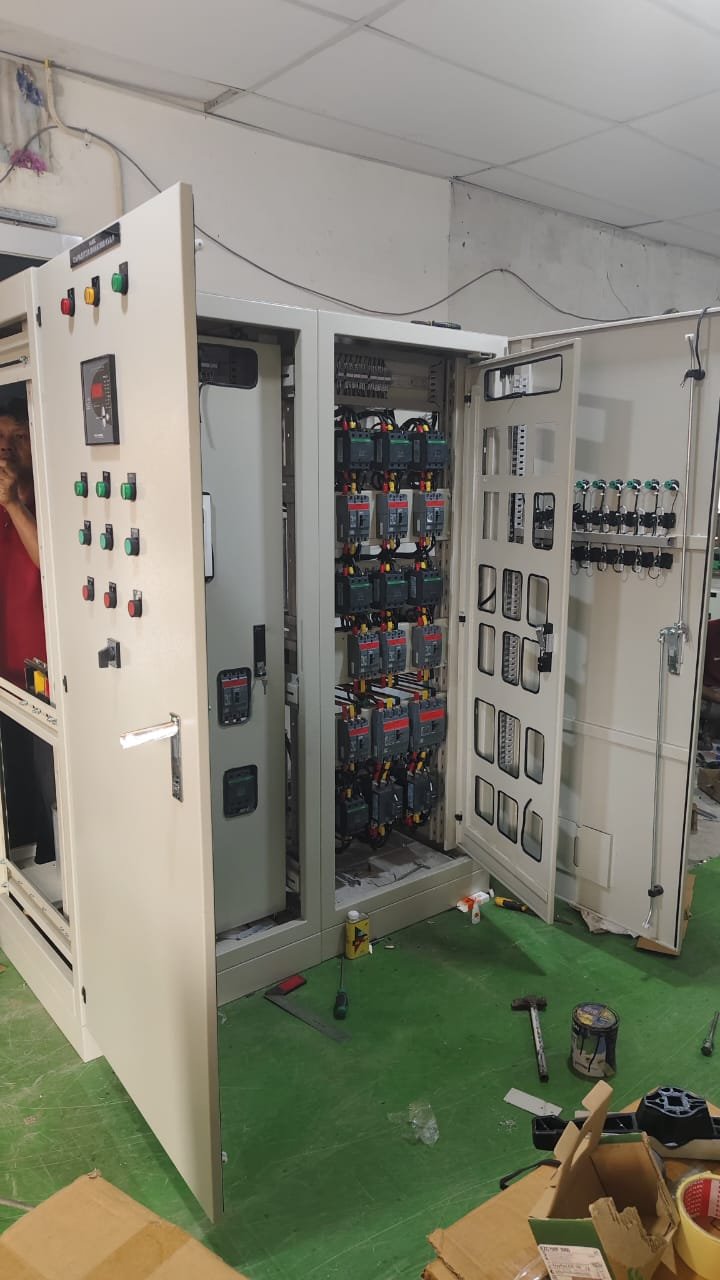
Preventive maintenance for industrial LVMDP switchboards and Air Circuit Breakers (ACB) follows a disciplined schedule: semi-annual infrared thermographic scanning under peak load to detect high-resistance joint hotspots, coupled with annual major servicing covering enclosure vacuuming, arc chute de-carbonization, mechanism lubrication, Ductor micro-ohm contact resistance audits (<50 µΩ), and secondary injection trip calibration.
Full-Load Infrared Thermographic Hotspot Auditing
Over 80% of industrial electrical fires originate from loose copper busbar bolted joints. Micro-gaps increase contact resistance, generating severe thermal energy at high currents (Thermal energy = I²R).
Our calibrated Fluke infrared thermal imagers audit switchboards under peak operating load without disconnecting power. Delta-T temperature differentials exceeding 15°C are flagged for immediate rectification.
Air Circuit Breaker (ACB) Servicing & Arc Chute Overhauls
Master Air Circuit Breakers (such as Schneider Masterpact NW and ABB Emax) are the primary defense against catastrophic plant short-circuits. Over operational cycles, arc chutes accumulate metallic vapor and carbon soot.
Our engineers rack out breakers, de-carbonize arc chutes, lubricate mechanical charging linkages, and record Ductor micro-ohm contact resistance across each phase pole.
Calibrated Torque Auditing & 1,000V Megger Testing
Every copper busbar bolt is re-torqued using calibrated torque wrenches complying with DIN/ISO standards (e.g. M10 bolts = 45 Nm; M12 bolts = 80 Nm).
Following deep vacuum de-dusting, a 1,000V Megger insulation resistance test is conducted phase-to-phase and phase-to-ground, requiring values >100 MΩ prior to re-energization.
Frequently Asked Questions
How often should a complete LVMDP shutdown overhaul be scheduled?
We recommend executing a comprehensive shutdown overhaul once annually, timed to coincide with planned annual factory turnaround maintenance.
Does BRT mobilize for night shift and weekend maintenance?
Yes. Our specialized service engineers operate around the clock on weekend or night shifts to ensure complete substation maintenance without impacting commercial production schedules.

Gatot Baskoro Adi
With over 18 years of medium-voltage electrical engineering leadership since 2008, Gatot Baskoro Adi holds three SKK Level 5 licenses issued by PT Andalan Profesi Elektrikal Indonesia under the Ministry of Energy and Mineral Resources. He has directed more than 23 major industrial projects and 8 completed installations for Malaysian conglomerate KLK Group across Sumatra and Kalimantan.